
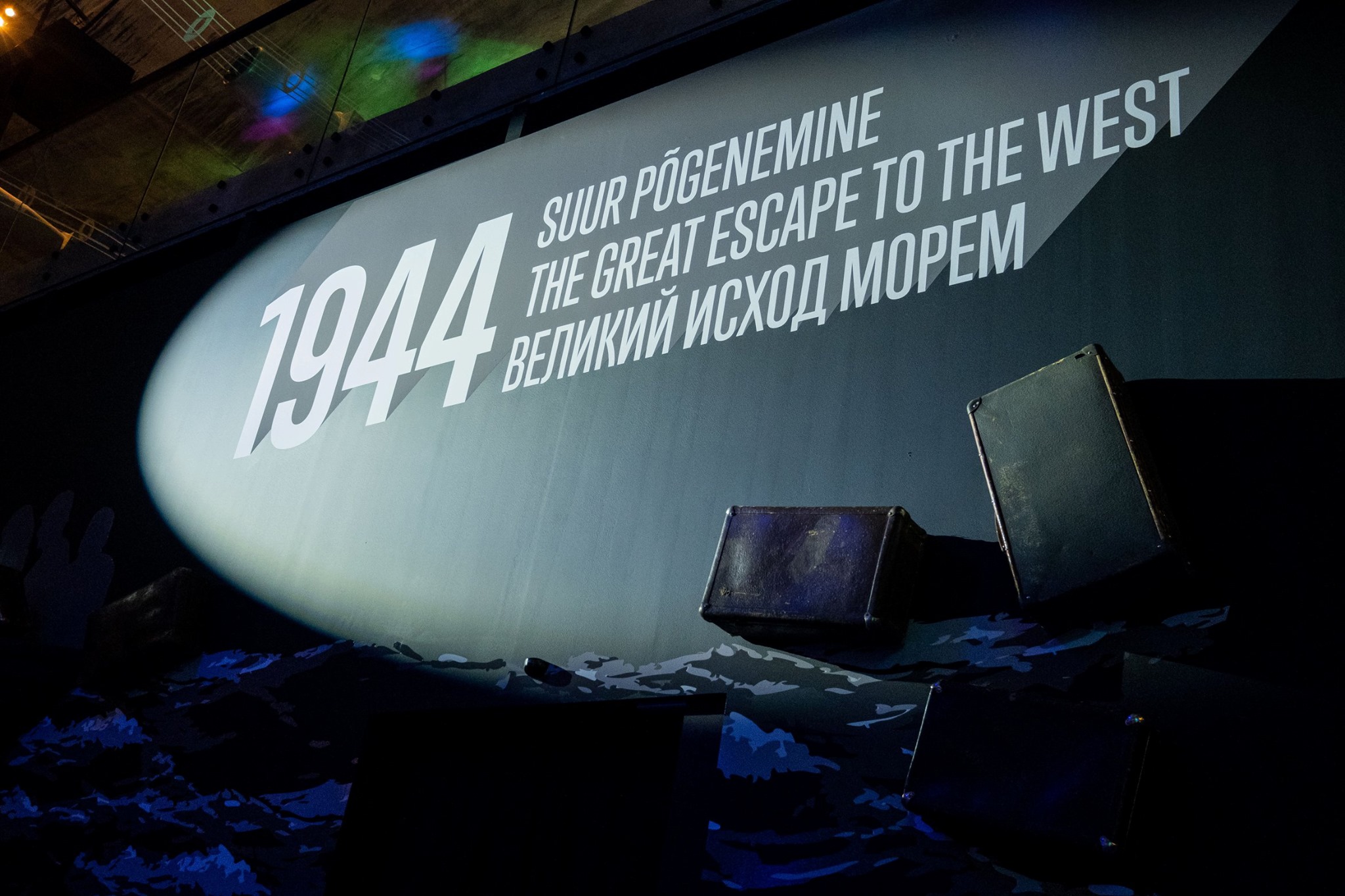
1944 The Great Escape to the West
In the autumn of 1944, as the Soviet army advanced, some 80,000 people fled Estonia across the sea. They did not leave by choice. It was an escape.
1944 – The Great Escape to the West is an audio-visual exhibition about twists of fate and flight across the Baltic. Visitors choose one of seven real people — teenagers, a soldier, an entrepreneur, a naval officer and a minister — who left from different parts of Estonia for Finland, Sweden and Germany, and follow that person’s journey on headphones through three chapters: Leaving home, At sea and Arrival.
The stories are built on the memories of those who survived the journey and are staged as audio dramas, with bystanders’ voices and a soundscape for each scene. The memories of those who fled as teenagers are voiced by young people of the same age. Each chapter is hidden from the next by curtains. Archive film shows Estonian towns in 1944; visitors sit on boat benches before a projection filmed on a windy night on the Baltic; and Swedish Television’s footage shows the motor sailboat Juhan reaching Sweden with refugees.
The exhibition opened at Seaplane Harbour in 2019, 75 years after the escape. Its subject is sadly still relevant: in different parts of the world, people are still driven from their homes by war, oppression or authoritarian rule. The exhibition can be adapted by adding or replacing characters with stories from the host country’s own history.
“Everything is quiet on the night before 10 August 1944. But on my way from the village to the vicarage, I notice Red Army light tanks by the woods – a sign that the front has broken. … It is clear: we must leave the village. We have become refugees.”
- Seven personal audio stories based on real memories, in Estonian, English and Russian
- Character charts: each visitor chooses whose journey to follow
- Three chapters — Leaving home, At sea, Arrival — each built around a projection
- Night-time footage filmed on the Baltic Sea, watched from boat benches
- Swedish Television archive footage of the refugee boat Juhan arriving in Sweden
- Adaptable: characters can be added or replaced with stories from the host country
PARTNERS
- Estonian Maritime Museum
- Katrin Sipelgas