
Estonia – one ship story
On the night of 28 September 1994, the ferry Estonia sank in the Baltic Sea. Of nearly 1,000 people on board, only 137 survived. It remains the deadliest peacetime shipping disaster in the Baltic Sea.
Thirty years later, the Estonian Maritime Museum built an exhibition to hold that memory — not to investigate the disaster, but to remember the ship and the people whose lives it carried. It was created with survivors, crew members and families of the victims, whose voices shaped every decision, down to what the exhibition deliberately leaves out.
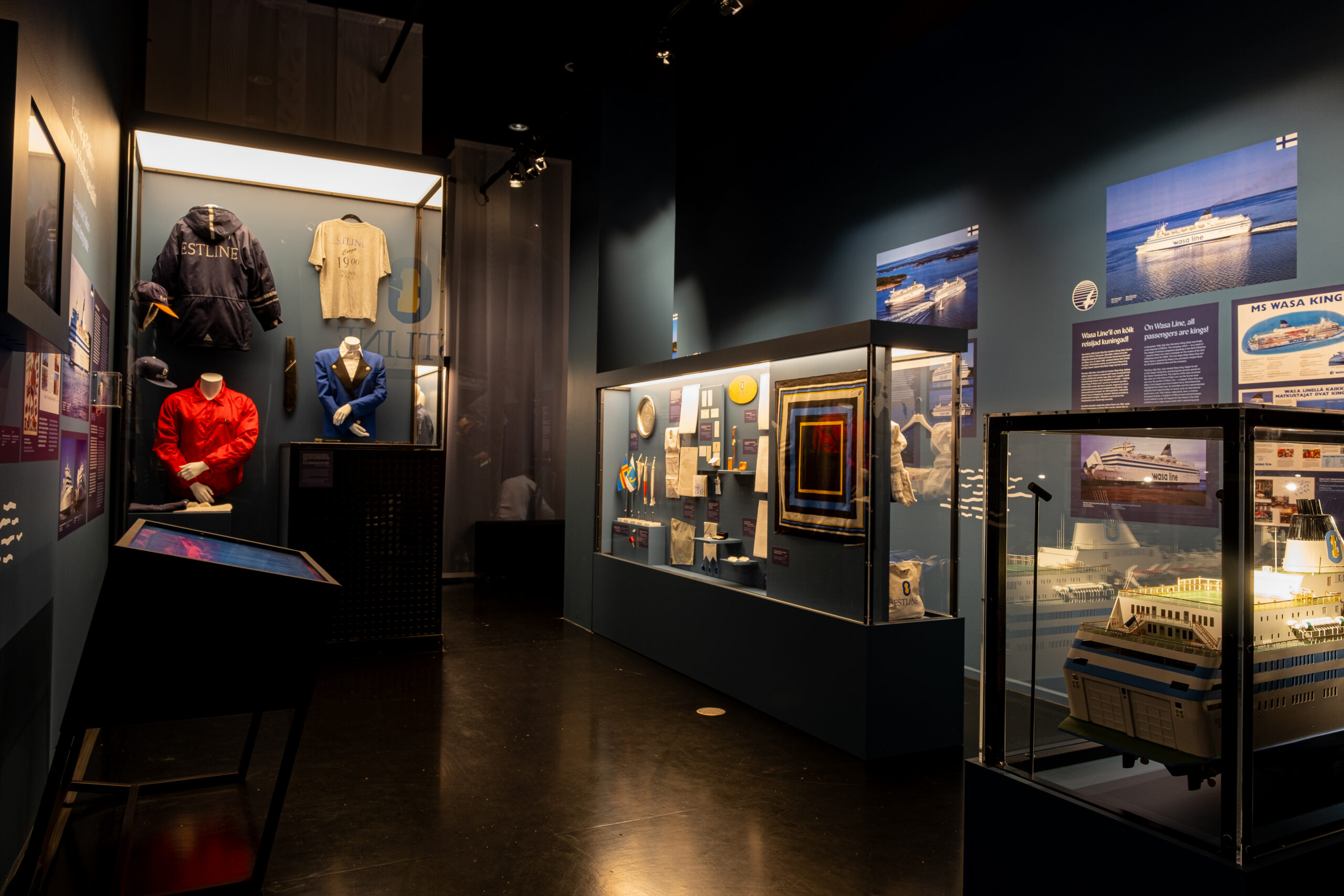
The exhibition traces the ship’s whole life: her build at Meyer Werft in Germany in 1980, her years sailing as Viking Sally, Silja Star and Wasa King, her transformation into the pride of the newly independent Estonia, and finally that last, unfinished crossing from Tallinn to Stockholm. It is a portrait of a ship, and a quiet space to reflect.
The touring version is a focused selection from the 95 original objects shown in Tallinn. Accessibility is built in and adapts to each host country — the sign-language guide can be re-recorded in the sign language of the host audience.
- Original documents from the ship's life and last voyage
- Personal belongings of passengers and crew
- Archival footage from the Estonian and Finnish national broadcasters, on three multimedia screens
- Sign-language guide, adaptable to the host country's sign language
- Crew uniforms from the Estonia
PARTNERS
- Survivors, crew members and families of the victims of the Estonia
- Ostrobothnian Museum (Pohjanmaan museo), Vaasa, Finland
- Swedish and Finnish partner museums
- Private lenders
- Estonian Public Broadcasting (ERR) and Finnish Public Broadcasting YLE
- Accessibility consultants