Hell on the Baltic Sea
On the night of 28 August 1941, some 15,000 people died and more than 60 ships were lost in the Gulf of Finland, off the Juminda Peninsula in Estonia. Around five times as many people died as at Pearl Harbor. It is one of the worst maritime tragedies in history, and one of the least known.
That summer, German troops had pushed the Soviets out of Estonia and cut off the retreat by land. The Finns, allied with Germany, had spent the summer mining the Gulf of Finland, and the largest minefields lay off the Estonian coast at Juminda. The only way out for the Red Army was by sea, from Tallinn to the Kronstadt naval base near Leningrad. The evacuation was organized in great haste: a convoy 50 kilometers long, carrying more than 50,000 people — retreating soldiers, the local power elite with their families, forcibly mobilized Estonians and political prisoners. The fleet headed straight into the minefield.
The exhibition tells this story through the people who lived it. Visitors enter a long wave-like corridor between two black walls — the two dark forces — and follow the night chronologically: the eve of the evacuation, the convoy reaching the minefield, the first ships striking mines, the chaos of the night, and the morning after, with German aircraft bombing the ships still trying to escape. In niches along the curved walls, visitors sit and listen to survivors through headsets while the speaker’s photograph is on the screen. Each account is heard in its original language — Estonian, Russian, German or Finnish — and subtitled.
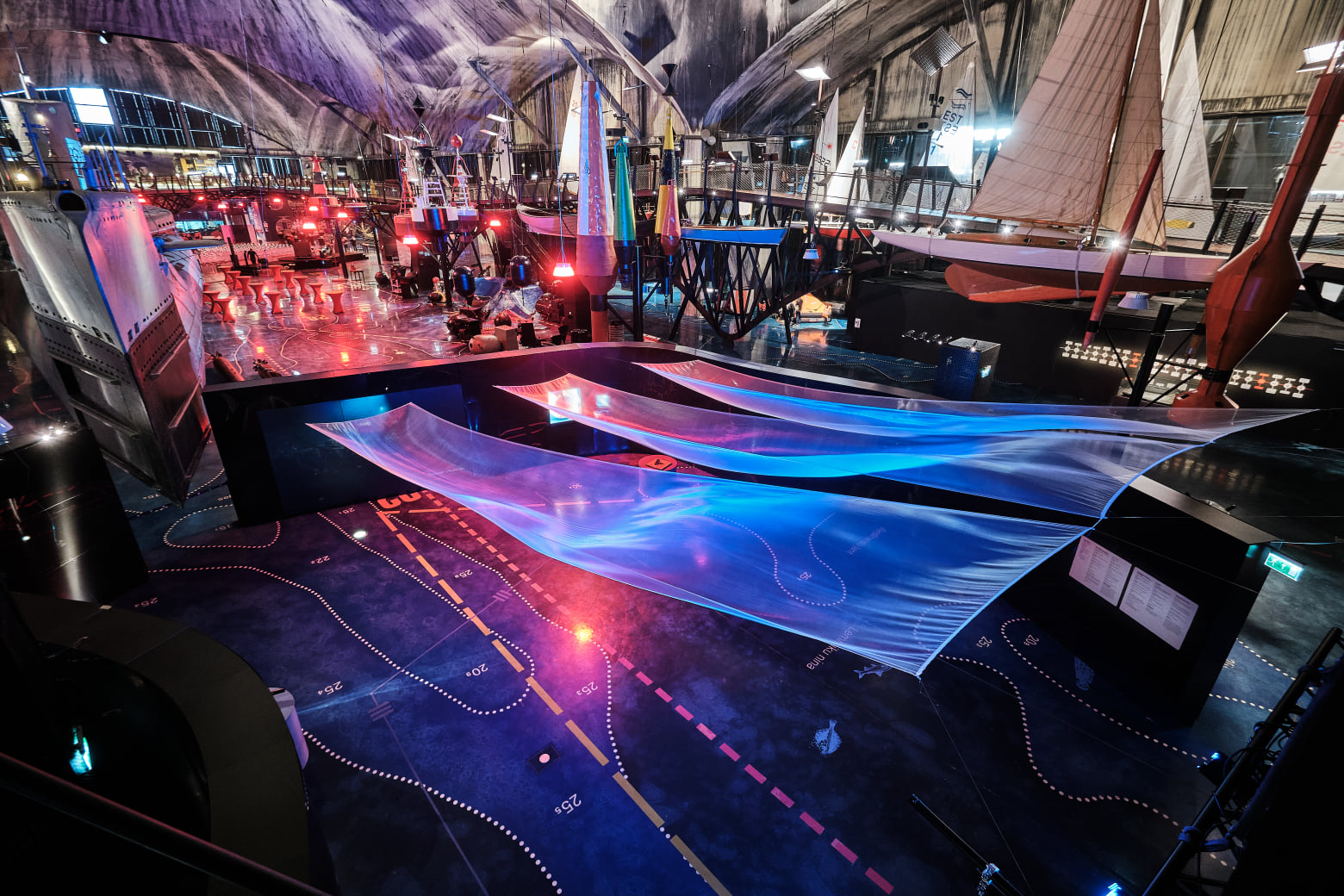
At the center, the minefield. A transparent screen overhead shows the shadows of ships passing above, as if seen from the seabed, while a horizontal fabric holds people and pieces of ships sinking through the water.
The exhibition was built on the memories of 51 people, in 155 fragments, and opened at Seaplane Harbour on the 80th anniversary of the battle. It was designed from the start so that visitors with impaired sight, hearing or mobility can experience all of it.
Although the exhibition tells the events mainly from the Estonian perspective, its design allows the focus to be adjusted to the country in which it is shown — the Finnish role in the 1941 events at Juminda, for example, can be brought forward.
“We stand ready to leave the port of Tallinn. The bullets had already fallen into the sea close to us.”
- The memories of 51 survivors and eyewitnesses, in 155 fragments, each heard in its original language
- The minefield installation: ships passing overhead on a transparent screen, people and wreckage sinking through the water below
- Around 20 objects and replicas, each with its own story, alongside real naval mines
- Animations showing how a naval mine is built and how it works
- The two surviving ships of the convoy — the icebreaker Suur Tõll and the submarine Lembit — both museum ships in Tallinn today
- A closing section on the wrecks: what is known today, and what WWII wrecks mean for the environment
- Accessibility built in sign language on every memory screen, induction loops at every listening point, a tactile guidance strip, a tactile floor plan, a relief map of the minefield and convoy, and tactile 3D models of the submarine Lembit and of a wreck on the seabed
- Built for slow viewing: the exhibition deliberately has no hands-on elements, the subject being too serious for them
PARTNERS
- Estonian Maritime Museum / Seaplane Harbour
- Narrative and direction: Jaak Kilmi and Kiur Aarma
- Design: Ülo-Tarmo Stöör and Katrin Sipelgas (Filmikunst OÜ); graphic design: Daniel Villems
- Production: Filmikunst OÜ; Fratelli Grupp
- Lenders: Tallinn City Museum, Virumaa Museums, Vabamu Museum of Occupations and Freedom, Estonian Bicycle Museum, Sõru Museum, Forum Marinum (Turku, Finland) and private collections
- Archive material from Estonian, Finnish, German and Russian audiovisual archives